

4 January 2026
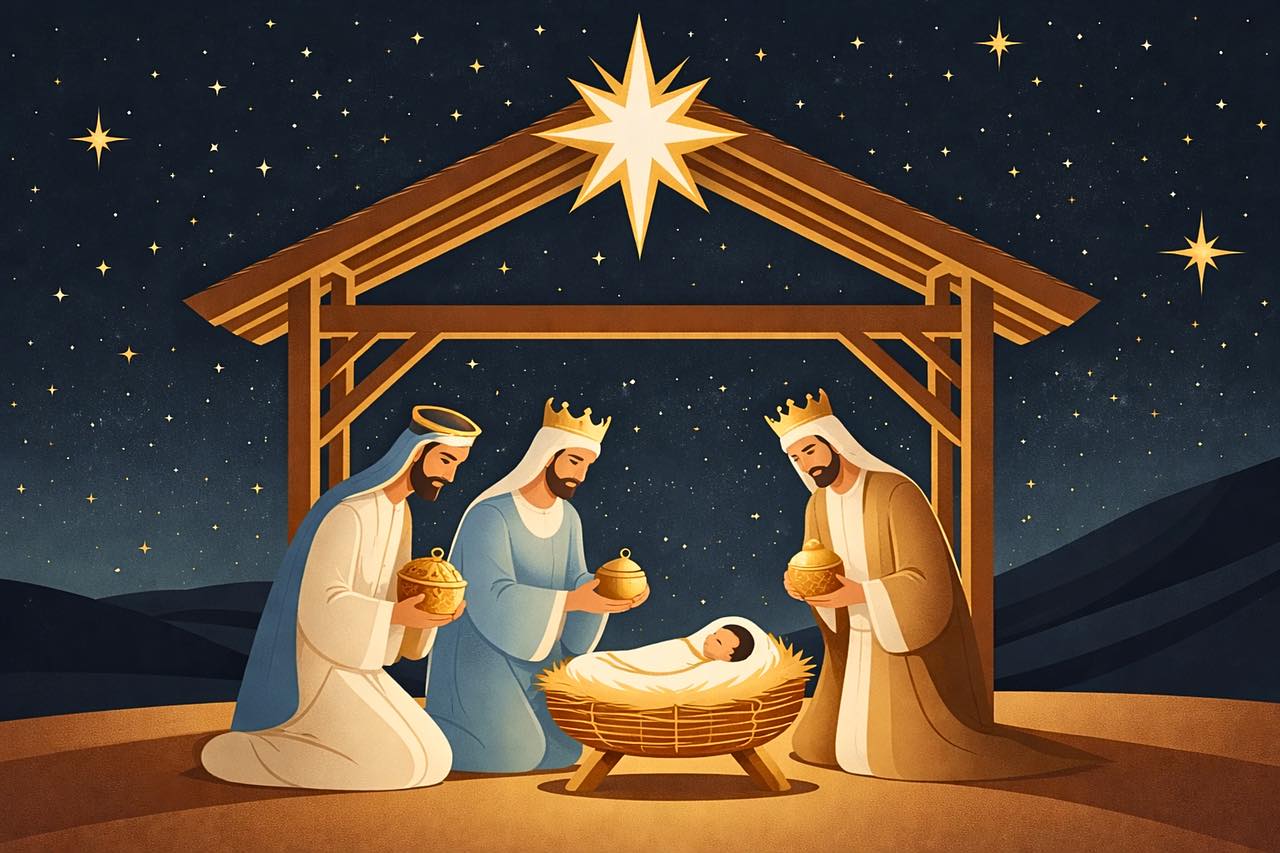
Dear friends, grace and peace to you on this glorious Solemnity of the Epiphany! Today, the Church celebrates the revelation of Jesus Christ to the world, not just to a chosen few, but to all peoples, all nations, all cultures. The word “Epiphany” comes from the Greek, meaning “manifestation” or “showing forth.” And what a magnificent showing it is! In the Gospel from Matthew, we encounter the Magi—the wise men from the East, often called kings—who journey from distant lands to adore the newborn King. Their story is not just a charming tale of stars and gifts; it’s a profound invitation for us to see Christ as the light for every human heart, no matter where we come from.
Imagine these wise men: astrologers, scholars, perhaps even rulers from the Orient—modern-day Persia or beyond. They weren’t part of the Jewish people; they didn’t know the Scriptures intimately like the shepherds or the prophets. Yet, guided by a star, a sign from God in the heavens, they set out on a perilous journey across deserts and unknown territories. They left behind their comforts, their familiar cultures, and their own wisdom traditions to seek something greater. Why? Because they recognized that true wisdom isn’t confined to books or stars; it’s found in a person: Jesus Christ, the Word made flesh.
Their coming from faraway lands teaches us something essential: the Lord is for all peoples. Jesus isn’t the savior of one race, one culture, or one nation. He is the universal King, the light that pierces every darkness. In a world divided by borders, prejudices, and ideologies, the Epiphany reminds us that God’s love knows no boundaries. The Magi represent the Gentiles, the outsiders, being drawn into the mystery of salvation. This is why Saint Paul, in today’s second reading from Ephesians, speaks of the “mystery” revealed: that “the Gentiles are coheirs, members of the same body, and copartners in the promise in Christ Jesus through the gospel.” No one is excluded. Whether you’re from the bustling streets of Iriga City or the remote peripheries of our world, Christ calls you.
And this universality extends even to the public square. Today, we’ve invited our esteemed Mayor, Rex Oliva, and his companions to join us in this liturgy—not as spectators, but as participants in the worship of the King. Just as the wise men, who were likely influential figures in their societies, bowed before Jesus, so too are our leaders called to recognize Christ’s lordship in public life. The Epiphany challenges us to bring the light of Christ into our communities, our politics, our workplaces. It’s a call to evangelize the public square with humility and truth, showing that faith isn’t a private affair but a gift for the common good.
Look at how we’ve involved our children today in reenacting the adoration of the three kings. These little ones, with their innocence and purity, remind us of the virtues we so desperately need: innocence that trusts without cynicism, and integrity that acts without compromise. In a world tainted by corruption and self-interest, our children proclaim a message louder than words: return to the simplicity of adoring Christ. They tell the world that true kingship isn’t about power or wealth, but about kneeling in wonder before the divine child.
Now, let’s turn to the gifts the wise men brought: gold, frankincense, and myrrh. These aren’t random offerings; they’re rich in symbolism, speaking to who Jesus is and what he calls us to be—especially in our greedy, materialistic world today.
First, gold: the gift for a king. Gold represents royalty, value, and enduring wealth. The Magi recognized Jesus as the King of kings, not Herod with his earthly throne. In our time, when society chases after material riches—a collection of mansions, of luxury cars, bags, and watches, endless consumption—gold reminds us that true treasure is found in Christ. We’ve become a people enslaved to greed, where success is measured by bank accounts through ghost projects rather than by integrity and love. But Jesus invites us to store up treasures in heaven, where moth and rust do not destroy. The wise men sought wisdom from Jesus; fools seek it from money. As Proverbs tells us, “Wisdom is better than gold.” Let us ask: Where is our heart? In the fleeting glitter of this world, or in the eternal kingship of Christ?
Second, frankincense: the incense used in worship, symbolizing divinity and prayer. This gift acknowledges Jesus as God, the one to whom our prayers rise like sweet smoke. In a secular age that dismisses the spiritual, where people fill the void with distractions—social media, entertainment, superficial pleasures—frankincense calls us back to adoration. It’s a reminder that we are made for worship, not just work. In today’s materialistic rush, we’ve forgotten the sacred. But the Epiphany urges us to offer our lives as a living sacrifice, our prayers as incense before the Lord. Let frankincense inspire us to deepen our prayer life, to make time for God amid the noise.
Finally, myrrh: an ointment used for anointing the dead, foreshadowing Jesus’ suffering and death. This bittersweet gift points to Christ’s humanity and his redemptive passion. Myrrh was costly, mixed with spices for burial. In our hedonistic culture that avoids pain at all costs, seeking comfort, youth, and escape, myrrh teaches us to embrace the cross. It’s a call to solidarity with the suffering: the poor, the sick, the marginalized. In a greedy world that exploits the vulnerable for profit, myrrh reminds us that true love involves sacrifice. Jesus didn’t come to be served but to serve, even unto death. The wise men, in offering myrrh, prophetically point to the resurrection beyond the tomb.
My dear friends, the Magi returned home “by another way”, not just geographically, but transformed inwardly. They had encountered the Light of the World, and it changed them. Today, as we celebrate this Epiphany, let us follow their example. Let us journey from our own “faraway lands”—our doubts, our materialism, our divisions—to adore Jesus anew. Let us bring our gifts: not just gold, but our resources shared with the needy; not just frankincense, but our fervent prayers; not just myrrh, but our willingness to suffer with Christ for others.
In this Mass, as we receive the Eucharist, the true presence of the King, may we be epiphanies ourselves, manifestations of Christ’s light in our families, our city, and beyond. To our Mayor and guests: thank you for being here; may this celebration inspire your service. To our children: your reenactment touches our hearts: keep that innocence alive!
May the star of Bethlehem guide us all, and may Saint Anthony of Padua intercede for us.